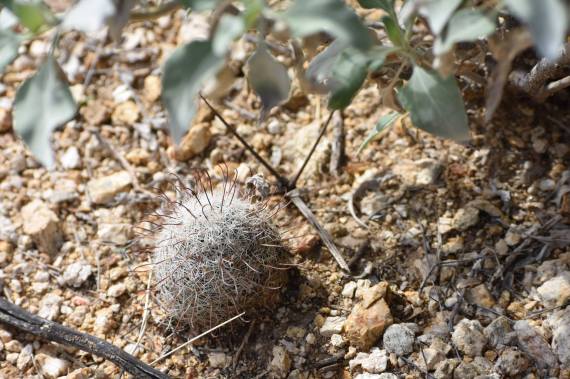
Principles of Multimedia Assignment 4: Video Sequence
A look at the University of Arizona’s Band Day, an annual high school marching band competition.
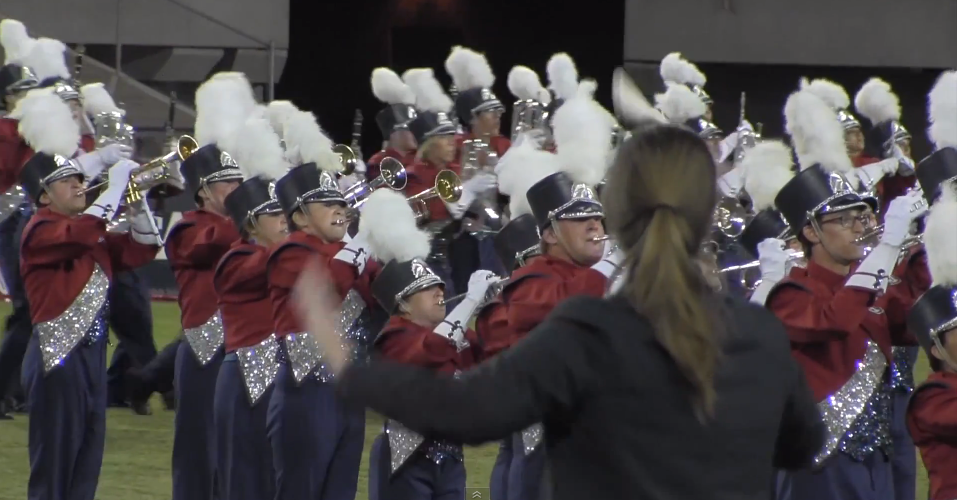
Principles of Multimedia Assignment 4: Video Sequence
A look at the University of Arizona’s Band Day, an annual high school marching band competition.
A video of what I did the summer of 2012.
MUSIC
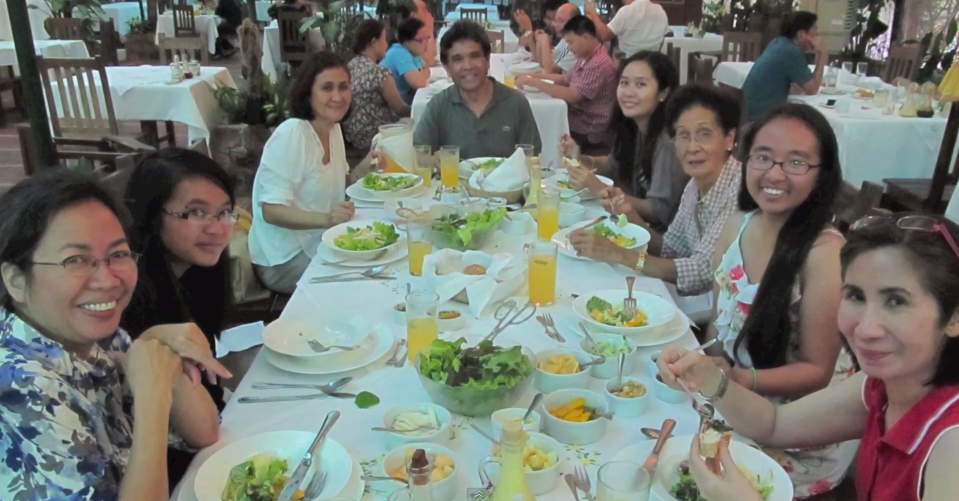
Map of the 2011 top ten locations for vehicle theft in Tucson, AZ.
Check out my map of nursing home complains here.
Advanced Reporting Assignment 1: Neighborhood Profile
TUCSON, Ariz. – Security signs are everywhere. Young Alarm. CCS Systems. Central Alarm. ADT. Protection One. Upon first impression, you’d think that Peter Howell was just another neighborhood living through the common belief that midtown Tucson is a crime-ridden area.
Its residents however, don’t feel like crime is any more predominant in their area than anywhere else in Tucson.
Chris Brooks, the president of the Peter Howell Neighborhood Association, says that the belief of there being a lot of property crime in the area is just a misconception.
Commercial areas surround Peter Howell along the edges. According to Brooks, that is where most criminal activity takes place. “When you get inside the neighborhood, it isn’t so bad,” said Brooks.
Peter Howell became a neighborhood in 1951. Evo DeCancini, attorney general of Arizona and a Justice of the Arizona Supreme Court, decided to develop suburbs on land he owned in Tucson to accommodate a boom in the population.
“What really boomed Tucson was World War II,” said Jim Turner, historian and former resident of Peter Howell. The bases and factories brought many people to Tucson. After the war, returning GIs and the baby boom continued to contribute to a huge housing shortage.
Turner moved into the neighborhood in 1951 when he was two years old. In the 50s, the community was full of young people and their families. “With the baby boom they couldn’t build grade schools fast enough. Almost every house had kids my age,” he said. “Halloween was just nuts. It was like hundreds of kids came by your house at Halloween.”
Turner, who also spent some time working as a journalist, recalled an interview with his grade school principal Al McQuary six years ago. McQuary used to warn his teachers about being impressed by their students’ high test scores. “He told them that ‘it’s not the quality of your teaching. These kids all come from upper middle class professional families. Their parents are lawyers, judges, engineers, dentists.’ ”
The neighborhood Turner remembers was full of highly educated, predominantly white, middle class families.
Peter Howell does remain predominately white, with 80 percent of residents being Caucasian, about 3 percent higher than the rest of Tucson.
However, it isn’t as young as Turner remembers. According to data from the 2010 U.S. Census, only a fifth of homes in the neighborhood have children. In comparison, nearly a quarter of homes in Tucson have children.
Though Turner no longer lives in the neighborhood, he hasn’t moved far from his childhood home. The small Scotts pine tree his grandfather planted in the 50s now towers at nearly 60 feet, marking his old home. When asked about his thoughts on the neighborhood today he said, “Rundown.”
It no longer has the same pristine up keeping that he remembers from his youth. Where there was desert landscaping in medians, now there are weeds. Where the streets were smooth, now they’re cracked.
Josephine Thoman has lived in the neighborhood her whole life. She, too, has watched it change and grow through the years.
Thoman has many fond memories of living in the neighborhood. She remembers the old YMCA, when there was only one drugstore in the area, and “when El Con was really a mall.”
She gestures down the street. “The way the streets were built, when it rained there would be so much water.” The children took advantage of that and floated down the makeshift river in whatever they could find. “Some kids went all the way to the river but I never did that. I stopped at 5th Street because I had to walk home.”
She points to a house across the street. “The woman that lived there, when we were trick-or-treating made us sing a song for candy.”
“Everyone knew everyone,” she said. “It was a lot of fun growing up.”
Beneath the idyllic sounding conditions, Peter Howell does have a history with crime. Elizabeth Quinn, the neighbor Thoman remembers, was murdered in her home. Quinn was found beaten to death in her home on East Kilmer Street in 2007. The case was never solved.
The Pied Piper of Tucson, a famous serial killer, also left his mark on the neighborhood.
“Charles Schmid was known as the Pied Piper of Tucson because he had so many followers. And he and his followers were wild. He decided he’d like to know what it was like to kill somebody,” Turner said.
According to Turner, in 1964 Schmid tricked Alleen Rowe into going into the desert under the ruse of going to a party. Instead, he murdered her.
Schmid’s girlfriend Gretchen Fritz witnessed the crime. During a messy breakup between the two, Fritz threatened to expose Schmid. He then took Gretchen and her sister Wendy to the desert and murdered them.
Though his victims lived just outside of the Peter Howell neighborhood, many of the residents still knew Gretchen and Wendy Fritz. “My girlfriend at the time was a good friend of Gretchen’s,” Turner said.
“We thought they ran away to California because in 1966, everyone was running away to California,” Turner said. “Kids would go away in the summer and they’d come back with surfer haircuts.”
Schmid was eventually sent to prison for the murders. Despite successfully escaping once, he was caught and upon his return to prison was stabbed to death.
Despite past instances of violence, residents today are happy with the state of their neighborhood.
Rick Woodruff, 52, has lived in the area for 11 years. He was attracted by the central location but over the years, he’s appreciated the quiet neighborhood and amiable neighbors.
“It’s a good neighborhood to walk in,” Woodruff said. Though Peter Howell lacks sidewalks, the streets are wide and the neighbors friendly. “Once the sun goes down people come out to walk their dogs.”
As the sun sets, some residents emerge from their houses with their dogs leashed. The sun no longer beats down and the light breeze makes the Tucson heat bearable. Most smile and wave as they walk by.
“There is something that makes Peter Howell unique but I can’t quite put my finger on it.” Woodruff said. When asked what he would change about the neighborhood he simply replied, “Nothing.”
Principles of Multimedia Assignment 2: Natural Sound Slide Show
A look into the kitchen of Peking Palace in Tucson, Arizona.

Principles of Multimedia Assignment 1: Audio Slide Show
An audio interview with Trudy Mills, co-owner of Antigone Books in Tucson, Arizona. Mills speaks about the history of Antigone Books and how she came to own the store.

William Shakespeare is one of the most celebrated playwrights of all time, the most performed playwright of all time. Yet despite the beauty of his text, the words are difficult to understand.
In some Shakespeare productions, Meier said some actors convey the Elizabethan lines perfectly, while others are hard to understand. Pauses and inflection help convey meaning.
David Morden, one of Rogue Theatre’s Artistic Associates, will play Polixines. Morden teaches Acting and Shakespeare at Pima Community College. Shakespeare’s iambic pentameter is a rhythm similar to the beating of a heart; da DUM da DUM da DUM da DUM da DUM. Changes to this rhythm are significant and can hint to where a character is psychologically.
Morden said, “450 years later Shakespeare left us clues in his text so we could better understand him.”
Meier mentioned one method of Morden’s they’ll use to understand Shakespeare’s words. It’s called “Tarzaning” where the actors look at the skeleton of the text. They pick the words that lift the essential meaning out of the text. “Me Tarzan. You Jane.” Meier demonstrated.
The rest of the cast tried this method, among others, to learn how to approach Shakespeare’s text so it’s more understandable. One of the very first steps in the rehearsal process was to have a text rehearsal.
In a conference room on the side of the theatre, Morden leads the cast through Sonnet 121.
SONNET 121
‘Tis better to be vile than vile esteemed,
When not to be receives reproach of being,
And the just pleasure lost which is so deemed
Not by our feeling but by others’ seeing.
For why should others’ false adulterate eyes
Give salutation to my sportive blood?
Or on my frailties why are frailer spies,
Which in their wills count bad what I think good?
No, I am that I am, and they that level
At my abuses reckon up their own;
I may be straight, though they themselves be bevel.
By their rank thoughts my deeds must not be shown,
Unless this general evil they maintain:
All men are bad, and in their badness reign.
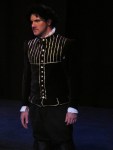
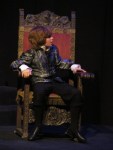
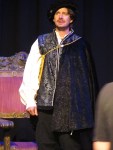
Cynthia Meier, the show’s director, also designed the costumes.
*click on an image to enlarge*



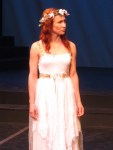
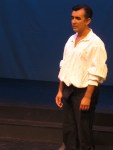
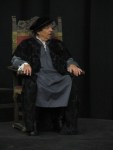
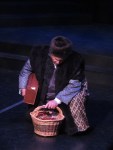


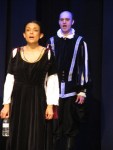
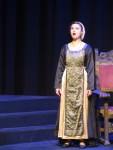

“Joe!”
“Avis!”
“Christopher!”
“Paul!”
“David!”
“Phil!”
“Cindy!”
The cast stands in a circle on stage, balls flying through the air, quickly changing hands as names are called.
This is how rehearsal begins, with a little warm up game. It helps loosen everyone up, both physically and vocally while also challenging everyone to remember each other’s names.

“And we’re back!” Leah Taylor, the stage manager, yells. Responses of “thank you, back” come from all over the theatre as actors take their places.
Meier takes her seat in the audience, this time in the portion facing the stage head on. As she waits for the shuffle of feet to die down to indicate that the actors are all in place, she pulls out a yellow notepad and pen to take down notes.
“Lights up!” Taylor says, signaling the start of the play.
Dawn Sellers, one of the production’s musical directors begins to play the harpsichord as the actors file out onstage for the opening number.
This opening song is one of the few moments when the whole cast in together on stage. Sellers said it was important to include everyone in this piece because it helps being them together.
For most of the rehearsal, Meier sits quietly in the audience, taking down notes to give the actors later. She interrupts occasionally fix the blocking and staging.
When Meier does give critiques, they are given kindly. Generally soft spoken, Meier is approachable. Her lack of an intimidating presence invites the actors to experiment with new and different things. Even when they fail or don’t work, she simply brushes it off and suggests another approach.

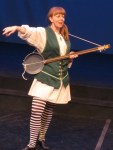
One of the greatest examples of an actor’s experimentation is Patty Gallagher’s antics as Autolycus. Gallagher is one of the main sources of comic relief in the show and actress is doing her best to show that. Her songs are backed with Amiel’s music and together the pair elicit laughs from their fellow cast members as Gallagher struts around with a fake guitar, instructing Amiel to play for her.
During rehearsal, Gallagher made multiple over the top acting choices; tuning her “guitar,” berating Amiel for not listening, rocking out to the music which eventually ends in her doing the splits. Nearly everything she did had the cast bursting with laughter. Meier praised her work but stayed clear in her vision and shot down an idea to come air guitar a portion of the song.
“That’s not where the joke is.” Meier said.

At a previous rehearsal, Leah Taylor had called an end to the break by blowing into a small horn. Today, she’s upgraded. “Places everyone,” she says.
How did you first get involved in theatre?
In high school, even thought I yearned to be on stage, I was too terrified to audition! I was on the stage crew for the all-school musical. One day before rehearsal, my friends and I were clowning around, acting out scenes from the show. The drama teacher pulled me aside and said, “You should be ON stage. That was really good.”
That same teacher talked me into auditioning for the next play, “A Midsummer Night’s Dream.” I was terrified at the audition and was hoping that maybe I could be cast as a fairy — I figured I could handle a few lines. When I saw I had been cast as Hermia, one of the romantic leads, I felt both exhilarated and as though I might vomit. The show went well, and I’m happy that my first stage role was such a wonderful one.
Why acting?
Can you tell me an interesting or amusing theatre story?
Are there qualities in your character that you also see in yourself?
Are there qualities in your character that you also see in yourself?
I’m in love. I think the similarities cease there though. Princessery is difficult to match in real life. Haha
 Kayla Samoy